Earth Testers
Earth testers, also known around the world as earth resistance testers or earth ground testers, are instruments used to measure the resistance of an earthing system to ground. They verify that fault currents, lightning strikes, and stray voltages have a low-resistance path to earth, which is essential for protecting personnel from electric shock and safeguarding connected equipment from damage. These instruments are widely used across electrical installations, industrial facilities, telecommunications sites, renewable energy systems, and lightning protection networks.
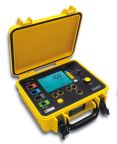
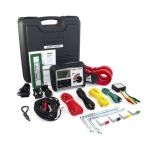
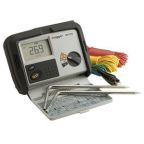
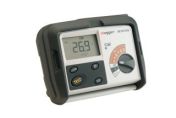
RS Australia stocks a comprehensive range of earth testers and detectors across clamp-type, handheld, desktop, and plug-in formats. Whether you need a portable earthing tester for field inspections or a precision earth resistance meter for fixed installations, our catalogue covers the full spectrum of electrical safety measurement requirements.
Types of Earth Testers
Earth testers are available in several form factors, each suited to specific testing environments and workflows.
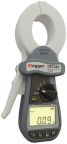
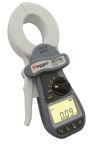
- Clamp-Type Earth Testers: Allow stakeless testing on live earthing systems without disconnecting conductors or driving auxiliary electrodes, ideal for routine maintenance where continuity cannot be interrupted.
- Handheld Earth Testers: Portable, battery-powered units designed for field technicians performing on-site measurements across multiple locations, with rugged construction suited to contractors and maintenance crews.
- Desktop Earth Resistance Testers: Bench-mounted instruments used in laboratories, calibration facilities, and fixed installations where high accuracy, wider measurement ranges, and repeatability are required.
- Plug-In Earth Testers: Designed for quick socket outlet testing, verifying the integrity of earth connections in domestic and commercial wiring without dismantling the installation.
Why is Earthing Testing Important?
A reliable earthing system protects personnel from electric shock and shields equipment from damage caused by fault currents, lightning activity, and transient voltages. Over time, earth electrodes and bonding conductors can degrade due to corrosion, soil movement, or physical disturbance, causing resistance to rise above safe thresholds.
In Australia, AS/NZS 3000 (the Wiring Rules) sets out earthing requirements for electrical installations, and periodic verification with an earth resistance tester or ground resistance tester is standard practice under most site maintenance schedules. Routine measurement using an earth resistance meter confirms ongoing compliance and identifies deterioration before it becomes a safety hazard.
Earth Resistance Test Methods
Several established methods exist for measuring earth resistance, and the right approach depends on site configuration, electrode type, and whether the system can be temporarily isolated.
3-Pole And 4-Pole Fall-Of-Potential
The Fall-of-Potential method is the reference standard for earth electrode testing, using auxiliary current and potential spikes driven into the soil at defined distances from the electrode under test. The 4-pole variant compensates for test lead resistance, improving accuracy when used with a precision earth ground tester.
Selective Measurement
Selective testing combines a clamp with the standard electrode method to measure individual electrodes within a multi-electrode system without disconnecting them, saving significant time on complex earthing networks.
Stakeless and Clamp-On
The stakeless method uses a clamp-type earth resistance tester on live systems where stakes cannot be driven, such as urban substations, rooftop installations, or established building earth loops.
2-Pole Testing
A 2-pole test offers a basic continuity check between two points, useful for rapid verification though less precise than a full measurement taken with an earth ground resistance meter.
Industrial Applications of Earth Testers
Earth testers are used across a wide range of industrial and commercial settings where electrical safety and equipment reliability are paramount.
- Electrical Installations and Compliance Testing: Licensed electricians use an earth tester to verify compliance with AS/NZS 3000 during new installations, periodic inspections, and switchboard upgrades.
- Industrial Facilities and Manufacturing Plants: Plant maintenance teams rely on an earthing tester to check grounding on machinery frames, motor enclosures, and control cabinets, protecting operators and sensitive automation systems.
- Telecommunications and Data Centres: Signal earthing and equipotential bonding are verified with an earth resistance meter to shield networking and server hardware from transient voltages and reference-ground noise.
- Renewable Energy Systems: Solar PV arrays and wind installations require inverter and array earthing checks using an earth ground tester to ensure fault currents are safely dissipated.
- Mining and Heavy Industry: High-risk sites demand frequent earthing verification with a ground tester to meet safety protocols near high-voltage assets and mobile plant.
- Lightning Protection Systems: Lightning rods, down conductors, and earthing electrodes are tested to confirm low-resistance paths that safely dissipate strike energy to ground.
The Leading Supplier and Distributor of Earth Testers in Australia
RS is a trusted supplier and distributor of earth testers in Australia, stocking dependable instruments from leading brands such as RS PRO, Megger, and Chauvin Arnoux. Earth tester prices vary depending on measurement method, accuracy class, and form factor, from compact plug-in units for socket outlet checks through to advanced earth ground resistance meter models designed for complex industrial earthing networks.
If you require other electrical test and measurement instruments such as network testers, multifunction installation testers, or clamp meters, you can find them in our online catalogue as well. RS Australia offers nationwide doorstep delivery on qualifying orders, making it easy to source the right earth tester for compliance testing, facility maintenance, and specialist site work. For more information on our delivery services and shipping options, please check out our delivery page.




Popular Searches
Related links
- Electrical Test & Measurement Accessories
- Fluke Earth Tester Kit
- Loop & RCD Testers
- A Complete Guide to Insulation Resistance & IR Testing
- Megger MFT1825 Multifunction Tester Earth Resistance Measurement With Australia Mains
- Fluke 1630-2 FC Earth Tester, 1.5kΩ CAT III 1000V
- Metrel MI-3155 Multifunction Tester Earth Resistance Measurement
- RS PRO MT-6600 Multifunction Tester Earth Resistance Measurement With Bluetooth, WiFi