Dies
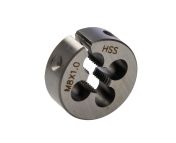
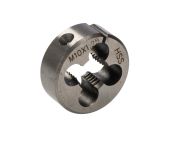
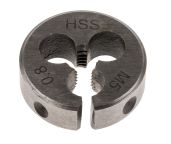
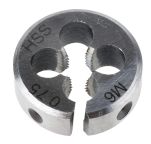
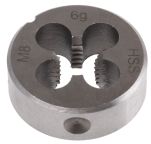
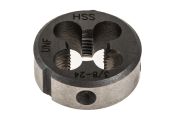
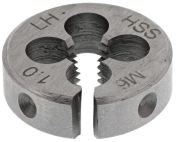
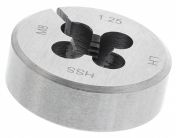
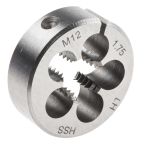
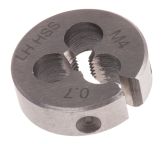
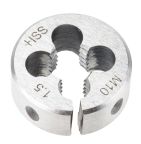
A high-quality, reliable threading tool is essential for workshops and industrial businesses that require threads measured to an exact metric thread size, which will give the pitch of the thread in millimetres (mm). At RS Australia, we have thread dies made from both standard steel and high-speed steel (HSS) available, meaning there is a choice of material to best suit your requirements. Our available products cover a range of metric sizes and pitches.
How Thread Dies Work?
Dies work by reshaping and removing material on a cylindrical workpiece to form external threads. It functions like a hardened nut, with internal threads that act against the blank as it is rotated. When the die is turned onto the pre-prepared rod, its cutting edges gradually remove material, carving a helical groove that matches the desired thread profile.
This thread-cutting action displaces chips of metal as the tool advances, creating a precise male thread that will mate with a corresponding nut or tapped hole. In some variants, such as thread-forming dies, material is plastically displaced rather than cut, but in both cases the die’s hardened surface is critical for shaping the workpiece accurately and consistently.
Feature and Benefits of Thread Dies
Dies offer a range of features that deliver real benefits for threading and metalworking tasks.
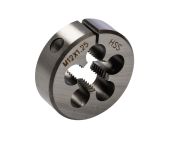
- Superior Heat Resistance: Dies made from HSS retain hardness even at elevated temperatures, allowing faster cutting speeds and longer tool life during continuous use without losing shape or strength. This makes HSS dies ideal for heavy-duty threading operations.
- Clean, Precise Thread Finish: Precision-engineered dies produce smooth threads with consistent profiles, minimizing surface imperfections and ensuring a good fit with mating parts, crucial for reliability and reduced wear in assemblies.
- Restore Rusted or Damaged Threads: Dies can re-thread worn or corroded threads on bolts and rods, restoring functionality without needing to replace components. Certain die designs are specifically extra thick for stronger rethreading.
- Compatibility with Standard Die Stocks: Dies are designed to work with common die stocks and holders, making them easy to mount and use with existing tooling setups for manual or machine-assisted threading tasks.
Applications of Thread Dies
Dies are widely used across industries where precise threaded connections are essential for assembly, repair, and fabrication work. Their ability to cut or form accurate external threads makes them indispensable in many professional settings.
Automotive Industry
In automotive workshops, dies are used to create or restore threads on engine components, bolts, and studs, ensuring secure fastening and fitment of critical parts. They help mechanics fix stripped threads and install replacement hardware efficiently, improving vehicle performance and safety.
Hydraulic Industry
Dies play a key role in hydraulic system maintenance and assembly, where threaded pipes and fittings must achieve leak‑proof connections. Using appropriate pipe dies, technicians cut clean threads on hydraulic tubing and components for fluid conveyance under high pressure.
Custom Machinery Fabrication
In custom machinery fabrication, dies are essential for producing threaded parts used in fixtures, fasteners, and structural elements. They are employed in workshops to make precise threads on rods, shafts, and bespoke components that integrate into larger mechanical assemblies.
Types of Thread Dies
Selecting the right die is crucial for accurate threading and efficient workflow in workshops and industrial applications.
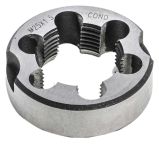
- By Shape: Round threading dies are ideal for creating new threads on rods and shafts, providing uniform threading across the workpiece. Hex threading dies, on the other hand, are commonly used for repair or rethreading work, allowing easy installation into standard die stocks or wrenches for restoring damaged threads.
- By Material: Carbon steel dies are suitable for general-purpose threading on soft metals, while HSS dies offer superior hardness and heat resistance, making them ideal for industrial applications, stainless steel, or frequent heavy-duty use.
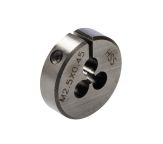
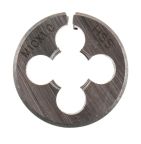
- By Adjustability: Solid dies have a fixed size and provide precise, consistent threads, whereas split dies are adjustable, allowing fine-tuning to achieve the perfect thread fit or compensate for wear.
How to Install Thread Dies?
Installing dies correctly is essential for producing clean, accurate external threads on a workpiece.
- Chamfer the Rod End: Start by shaping a slight bevel or chamfer on the end of the rod before threading. This chamfer helps the die align and engage smoothly with the workpiece, reducing the risk of cross‑threading and making it easier to start the cut.
- Apply Cutting Fluid: Before cutting, apply appropriate cutting fluid to both the rod and the die. Lubrication reduces friction, improves surface finish, and helps prolong the life of the die.
- Use the Forward‑and‑Reverse Method: Place the die in the die stock, keep it square to the rod, and turn two full rotations forward, then one turn back. Repeating this pattern helps break and clear chips, preventing buildup and ensuring smoother thread formation.
How to Choose the Right Thread Dies?
Choosing the right die ensures accurate threads and long tool life by matching the tool to your material, thread standard, and workspace constraints.
- Workpiece Material: Select dies based on what you’re threading. For stainless steel and harder alloys, HSS or cobalt‑enhanced HSS dies offer superior heat resistance and durability compared with basic carbon steel, reducing wear and improving performance.
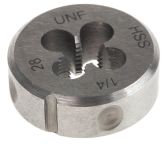
- Thread Standard: Ensure the die matches the required thread form, whether Metric (e.g., M6, M8 or M10) or imperial standards like UNC/UNF. Using the correct standard prevents mismatched fittings and ensures compatibility with corresponding nuts or tapped holes.
- Space Constraints: Think about where you’ll be working. Hex dies are easier to use with wrenches in tight areas or without a die stock, while round dies are preferred with holders for controlled manual or machine threading.
Thread Dies Manufacturer, Supplier & Distributor in Australia
RS is a trusted manufacturer, supplier, and distributor of high-quality dies in Australia, supporting a wide range of threading, cutting, and metalworking applications. Explore our extensive catalogue of thread dies from established brands like Dormer, Tivoly and Facom.
Besides thread dies, you can also shop for other essential workshop tools such as scribers, engineer squares, and more, making RS a convenient one-stop source for precision engineering tools.
Place your order online or by phone and enjoy fast delivery. For full details on delivery choices and applicable charges, please visit our delivery page.




Related links
- Threading Tap & Die Sets
- RS PRO 12-Piece HSS Thread Tap & Die Set M2 - M6 Dies
- RS PRO Threading Die M6, 20.63 mm OD
- Roofing Bolts
- Ega-Master 4-Piece Cast Iron Thread Tap & Die Set 1/4 in - 2 inch Dies
- Ega-Master 4-Piece Cast Iron Thread Tap & Die Set 1/4 in - 2 inch Dies
- Ega-Master 7-Piece Cast Iron Thread Tap & Die Set 1/4 in - 2 inch Dies
- Ega-Master 7-Piece Cast Iron Thread Tap & Die Set 1/4 in - 2 inch Dies