Feeler Gauges
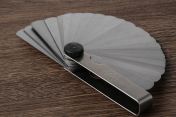
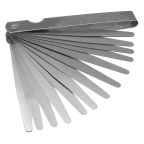
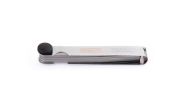
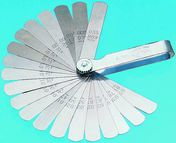
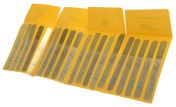
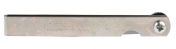
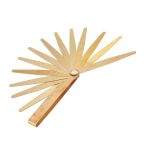
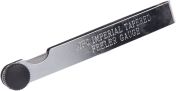
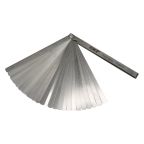
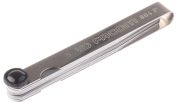
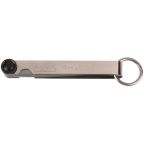
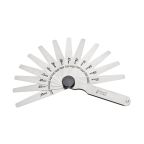
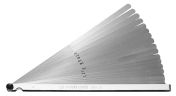
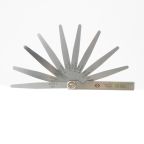
eeler gauges, also known as feeler blades or gap gauges, are precision tools for measuring small clearances between two surfaces.
These handheld tools utilise a set of short, rounded blades of fixed thicknesses to determine distance. The user slides the blade into the gap, relying on a slight ‘drag’ to confirm the correct measurement.
This method offers significantly more accuracy than using a traditional ruler or measuring tape for very small distances.
At RS Australia, we carry a wide range of feeler gauges in various sizes, materials, and measurement systems, including metric and imperial options, for every professional need.
How Do Feeler Gauges Work?
A feeler gauge tool works by physical insertion, relying on the feeling of slight drag rather than visual alignment (as with a tape measure) to measure clearances precisely.
This approach uses a 'Go/No-Go' strategy:
- Estimate the gap: Start by estimating the clearance size and selecting a feeler blade that is slightly thinner than the expected clearance.
- Insert the blade: Align the feeler blade and carefully attempt to slide it straight into the opening.
- Check for drag ('Go'): The blade should slide in with a slight, consistent drag, confirming the size is correct.
- Test the next size ('No-Go'): Test the next larger blade. If it does not fit or requires too much force, the preceding blade was the correct measurement.
- Final reading: The measurement is determined by the thickest blade that slides easily into the gap with a subtle friction.
Types of Feeler Gauges
Feeler gauges come with various measurement systems, providing flexibility across different standards. Some comprehensive sets also feature both measurements.
Imperial Feeler Gauges
These are predominantly used in North America, where the imperial system is the standard for mechanical specifications.
Feeler blades typically range from narrow clearances like 0.0015 inch up to thicker blades measuring 0.025 inch. They are essential for mechanics and engineers working with machinery and tools designed to imperial specifications.
Metric Feeler Gauges
As the metric system is utilised by almost every country outside North America, including Australia, metric feeler gauges are a global norm.
These feeler blades range from a narrow 0.04mm up to thicker blades that measure 1.00mm. This makes them suitable for international components and precision engineering tasks requiring the metric system.
Feeler Gauge Materials
Feeler gauges are manufactured from various materials, making them suitable across different job requirements and environmental conditions.
- Stainless Steel Feeler Gauges: Stainless steel feeler gauges are favoured for their excellent corrosion resistance, durability, and high accuracy. They retain their structure even after heavy use, making them ideal for professional work in humid or harsh environments.
- Steel Feeler Gauges: Standard steel feeler gauges offer a more affordable option but have lower corrosion resistance than their stainless steel counterparts. They are best suited for dry environments and general-purpose use where cost is a primary consideration, though they require regular oiling.
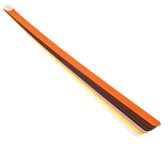
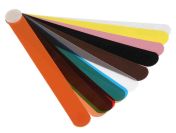
- Plastic Feeler Gauges: A highly cost-effective option, plastic feeler gauges are specifically suited for measuring gaps on delicate instruments or magnetised surfaces. However, they tend to exhibit faster wear and tear compared to metal options.
Industrial Applications of Feeler Gauges
Feeler gauges are indispensable precision tools used across a multitude of technical and industrial settings in Australia.
Automotive
Mechanics use feeler gauges extensively for precise adjustments, such as checking spark plug gaps or setting valve clearances in engines. This critical application ensures optimal engine performance and fuel efficiency.
Engineering and Machining
In machining workshops, feeler gauge tools are used to determine gaps between cutting tools and workpieces. This application is crucial for maintaining tight tolerances and ensuring the dimensional accuracy of manufactured parts.
Electrical and Industrial Equipment
Technicians rely on feeler gauges to measure clearances in electrical contacts or relays. This ensures that industrial switches operate correctly and prevents premature wear or malfunction, which are crucial to industrial electrical safety.
Quality Inspection and Calibration
A gap gauge is essential for quality control departments, enabling users to verify that manufactured components meet required specifications. Additionally, they are frequently used to calibrate tools and test fixtures to ensure measurement accuracy.
Buy Reliable Feeler Gauges Online at RS Australia
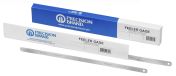
As your trusted supplier and distributor of measuring tools, RS Australia offers a comprehensive selection of feeler gap gauges. Our products are sourced from reputable brands like Precision Brand, Vogel, Facom, and SAM, ensuring reliable and high-quality options for every application.
Beyond feeler gauges, we also offer a wide array of other measuring and marking options, such as punch and die kits and spirit levels, to meet all your test and measurement needs.
Explore our user-friendly online site for the full range and buy the perfect tool for your project. With our flexible and swift delivery options, we ensure that your items are shipped to your door at your convenience.
Find out more about our delivery times and fees on our delivery information page.

Popular Searches
Related links
- Parker GAUGE SET Stainless Steel Feeler Gauge, 4 Blades
- Precision Brand 09225 High Carbon Steel Feeler Gauge, 1 Blades
- Starrett 173MAT Stainless Steel Feeler Gauge, 13 Blades
- Vogel 414105 Brass 13 Blades
- CK T3527M 413 Steel Feeler Gauge, 13 Blades
- Precision Brand 09207 High Carbon Steel Feeler Gauge, 1 Blades
- Precision Brand 09240 High Carbon Steel Feeler Gauge, 1 Blades
- Starrett 173MA Steel Feeler Gauge, 13 Blades