Bridge Rectifiers
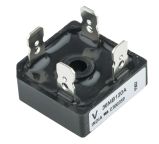
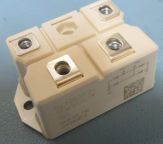
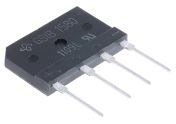
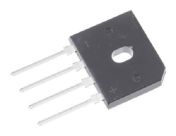
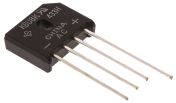
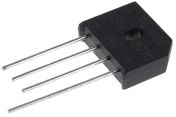
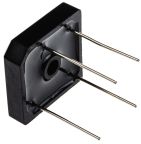
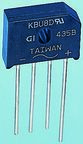
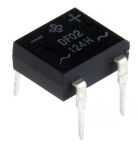
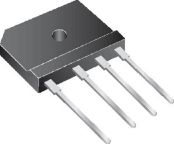
A bridge rectifier is a configuration of 4 or more diodes arranged in a bridge network that converts alternating current (AC) into direct current (DC). While a bridge rectifier can be built from individual discrete diodes wired into a bridge configuration, it is also widely available as a single packaged component, with all 4 diodes contained in a single block or encapsulation.
This makes it a foundational electronic rectifier in modern power management, forming the first conversion stage in most equipment that draws AC from the mains but runs on DC. RS Australia carries a wide range of bridge rectifiers to suit different phases, current, operating temperatures and more for all your semiconductor circuit needs.
How Diode Bridge Rectifiers Work?
A bridge rectifier delivers full-wave rectification by routing current through different diode pairs depending on the polarity of the AC input, so the output keeps the same polarity throughout the cycle:
- Positive Half-Cycle: When the AC input swings positive, current flows through a pair of diodes and across the load in a fixed direction.
- Negative Half-Cycle: When the input polarity reverses, current travels through the opposite pair of diodes but still passes through the load in the same direction.
- Full-Wave DC Output: Because both halves of the AC waveform are used, the result is a pulsating DC output of constant polarity. 2 diodes conduct during each half-cycle, allowing the 4-diode bridge to achieve full-wave rectification without a center-tapped transformer.
Applications of Bridge Rectifiers
Bridge Rectifiers are commonly used in power supplies to provide the necessary DC voltage for electronic components and devices, and they are found in various applications.
Domestic Appliances and White Goods
Bridge rectifiers are found in household appliances such as refrigerators, washing machines, and air conditioners. They convert mains AC into the DC required by internal control boards and motors.
Industrial DC Motor Drives
Many DC motors run on rectified DC power. Bridge rectifiers supply power to motors used in fans, pumps, machines, and automation systems, providing the DC stage that drives motor operation throughout the industrial plant.
Telecommunications Equipment
Bridge rectifiers are used in power supplies for telecommunications equipment and data centers, where continuous DC rails support network hardware.
Welding Infrastructure
Welding machines require a steady DC power source for consistent performance. Bridge rectifiers convert mains AC into DC, supporting high-quality welds with minimal spatter and arc interruptions.
Bridge Rectifier Types
Bridge rectifiers are classified by supply phase, control method, and mounting format.
- By Number of Phases: Single-phase bridge rectifiers are commonly used in lower-power equipment, while 3-phase bridge rectifiers are preferred for industrial and high-power applications. Uncontrolled 3-phase bridges typically use 6 diodes for higher-current conversion.
- By Control Method: Uncontrolled rectifiers use diodes to provide a fixed DC output. Controlled rectifiers use thyristors to adjust the output voltage, making them suitable for variable-voltage supplies and motor control.
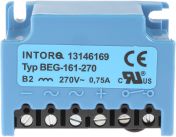
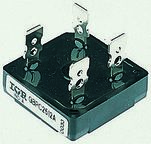
- By Mounting and Package Type: Common formats include surface-mount, through-hole, chassis, and DIN-rail packages. Heavy-duty chassis and stud-mount designs are used for higher-current applications. Selection depends on phase type, voltage rating, and current requirements.
Full Wave Rectifier vs. Half Wave Rectifier
A half-wave rectifier uses a single diode and converts only one half of the AC cycle, making it simple but less efficient. A full-wave bridge rectifier uses 4 diodes to convert both halves of the waveform, providing higher output and improved performance.
- Efficiency: Half-wave rectifiers achieve around 40.6% efficiency, while full-wave bridge rectifiers reach approximately 81.2%.
- Ripple Voltage: Half-wave rectifiers produce higher ripple (about 1.21), whereas full-wave bridge rectifiers have lower ripple (about 0.482), resulting in a smoother DC output.
- Component Count: Half-wave circuits require fewer components and lower cost, while full-wave bridge rectifiers use more components but deliver higher output voltage and power.
Compared with a centre-tapped full-wave rectifier, a bridge rectifier achieves the same full-wave conversion without requiring a centre-tapped transformer, reducing transformer size and cost. As a result, half-wave rectifiers are often used for simple, low-power prototypes, while full-wave bridge rectifiers are preferred for efficient production power supplies.
How to Choose Bridge Rectifiers?
Selecting the right bridge rectifier requires matching its ratings to the circuit's voltage, current, and thermal requirements:
- Peak Inverse Voltage (PIV) Rating: Each diode must withstand the maximum reverse voltage. In bridge rectifiers, designers typically choose a PIV rating 2 to 3 times the peak AC input voltage to provide a safety margin against transients.
- Forward Current Rating: The average forward current rating should exceed the maximum load current and accommodate surge currents during power-up.
- Forward Voltage Drop: Current passes through two diodes per half-cycle, creating an approximate 1.4 V drop in standard silicon rectifiers. Lower voltage drops reduce power loss and heat generation.
- Thermal Management: Adequate cooling and output filtering help maintain safe junction temperatures and ensure reliable operation.
Buy Bridge Rectifiers Online from RS
RS is a manufacturer, supplier, and distributor of bridge rectifiers, stocking an extensive range from leading brands, including Vishay, HY Electronic Corp, and DiodesZetex, as well as other trusted names. Beyond bridge rectifiers, we also have a broad catalog of semiconductors and sensors, including insulated-gate bipolar transistors (IGBTs) and temperature and humidity sensors.
For complete details on delivery times and charges, refer to our delivery page.
1666 Products showing for Bridge Rectifiers
In Stock
Subtotal (1 unit) $11.61(exc. GST) $11.61/unit |
In Stock
Subtotal (1 unit) $8.10(exc. GST) $8.10/unit |
In Stock
Subtotal (1 unit) $130.69(exc. GST) $130.69/unit |
In Stock
Subtotal (1 unit) $83.58(exc. GST) $83.58/unit |
In Stock
Subtotal (1 tray of 20 units) $213.86(exc. GST) $10.693/unit |
In Stock
Subtotal (1 unit) $121.70(exc. GST) $121.70/unit |
In Stock
Subtotal (1 pack of 2 units) $8.66(exc. GST) $4.33/unit |
In Stock
Subtotal (1 pack of 10 units) $9.82(exc. GST) $0.982/unit |
Last RS stock
Subtotal (1 unit) $8.58(exc. GST) $8.58/unit |
Last RS stock
Subtotal (1 pack of 5 units) $21.12(exc. GST) $4.224/unit |
In Stock
Subtotal (1 unit) $28.10(exc. GST) $28.10/unit |
In Stock
Subtotal (1 unit) $17.10(exc. GST) $17.10/unit |
Last RS stock
Subtotal (1 unit) $4.03(exc. GST) $4.03/unit |
In Stock
Subtotal (1 pack of 5 units) $10.49(exc. GST) $2.098/unit |
In Stock
Subtotal (1 pack of 2 units) $20.07(exc. GST) $10.035/unit |
In Stock
Subtotal (1 unit) $263.11(exc. GST) $263.11/unit |
Currently unavailable
Subtotal (1 unit) $86.51(exc. GST) $86.51/unit |
In Stock
Subtotal (1 unit) $19.08(exc. GST) $19.08/unit |
Being discontinued
Subtotal (1 unit) $80.59(exc. GST) $80.59/unit |
In Stock
Subtotal 5 units (supplied in a tube) $12.45(exc. GST) $2.49/unit |


Popular Searches
Related links
- Vishay Bridge Rectifier 8-Pin Single
- HY Electronic Corp Bridge Rectifier 4-Pin Single
- HY Electronic Corp Bridge Rectifier 5-Pin 3 Phase Bridge
- HY Electronic Corp Bridge Rectifier 5-Pin 3 Phase Bridge
- HY Electronic Corp Bridge Rectifier 5-Pin 3 Phase Bridge
- DiodesZetex Bridge Rectifier 4-Pin Single Phase
- DiodesZetex Bridge Rectifier 4-Pin Single
- Semikron Danfoss Bridge Rectifier Module 1600V 5-Pin
Be the first to know about our latest products and offers
Email address
The personal information you provide to us when signing up to this mailing list will be processed in line with the Privacy Policy