- Published 15 Jan 2025
- Last Modified 15 Jan 2025
- 7 min
A Comprehensive Guide to Spring Washer Uses, Types, and Applications
Wondering what a spring washer does? Discover the various spring washer types, their purposes, functions, and how to apply them in various assemblies.


This guide explores the diverse world of spring washers, covering their functions, applications, types, and best practices for installation.
What is a Spring Washer?

A spring washer, or disc spring, is a fastener specifically engineered to provide tension and preload in a joint assembly. Unlike flat washers, which primarily distribute load, spring washers have a conical shape that creates a spring-like effect when compressed. This spring function helps to prevent loosening, absorb shock, and maintain a consistent clamping force in joints that experience movement or vibration. Spring washers are often used in mechanical and industrial applications where secure and reliable fastening is critical.
What Does a Spring Washer Do?
The purpose of a spring washer is to provide tension and preload in a joint assembly. When tightened, the conical shape of the spring washer flattens, creating a spring-like force that pushes back against the fastener.
This mechanism works like o-rings in sealing off connections, preventing loosening, absorbing shocks, and ensuring consistent load distribution. By maintaining constant tension, spring washers help to prevent fasteners from loosening due to vibration, thermal expansion, or other external forces.
Spring Washer Applications and Uses
Prevent Bolt Loosening
Spring washers are highly effective in preventing bolt loosening in applications with vibrations or cyclic loading. For instance, spring washers are commonly used in suspension systems and engine components in the automotive industry to prevent bolts from loosening due to the constant vibrations and shocks experienced during vehicle operation.
Maintaining Tension in Joints
Spring washers are essential for maintaining tension in joints subjected to dynamic loads or temperature fluctuations. In the aerospace industry, for example, spring washers are used in aircraft structures and engine components to maintain tension in bolted joints, ensuring structural integrity and preventing loosening due to the stresses of flight.
Absorbing Shocks and Vibrations
The spring-like action of spring washers enables them to absorb shocks and vibrations, protecting delicate components and preventing damage to the joint assembly. For example, spring washers are often applied in electronic devices and circuit boards to absorb vibrations and prevent screws from loosening, securing sensitive components.
Withstanding Thermal Expansion
Spring washers can accommodate thermal expansion and contraction in materials, maintaining clamping force with the required tension even under temperature changes. As such, spring washers are commonly used in machinery and equipment that operate at high heat, such as ovens, furnaces, and engines, to maintain a secure connection despite thermal expansion and contraction of the materials.
Types of Spring Washers

Split Lock Washers
Split lock spring washers have a split ring design that creates outward pressure when tightened, biting into the fastener and the mating surface to prevent loosening. They are commonly used in applications where vibration or movement is a concern, providing a simple and cost-effective solution for preventing loosening.

Wave or Crinkle Washer
Wave or crinkle washers have a wavy or crinkled profile that provides a spring-like action when compressed. They offer a consistent load over a range of deflection and are often used in applications where space is limited or a low spring rate is required.

Toothed Lock Washers (Internal or External Teeth)
Toothed lock washers have teeth on either their inner or outer circumference, which bite into the fastener and the mating surface to prevent loosening. Internal teeth grip the fastener, while external teeth grip the mating surface, increasing the friction between the surfaces for a strong locking action.
Curved Spring Washers
Curved spring washers look like flat washers that have been slightly curved. The curved shape provides a consistent spring force while maintaining flexibility when compressed. They are commonly applied in cases requiring the absorption of movement, such as antennas and electrical connections.
Finger Spring Washers
Finger spring washers are spring steel washers with protruding flanges (“fingers”) around the circumference to provide additional spring-like qualities. The "fingers" reduce skidding on rotating elements, such as ball bearings and other rotating assemblies.
As a trusted supplier of spring washers, we at RS Australia source our washers from reputable brands, Shop spring washers at RS Australia to find the perfect component for your needs. such as ABB, Heico, and DeWALT, ensuring that each product complies with relevant standards. Enjoy the peace of mind that you’re buying a quality product when you shop with us.
Materials and Coatings of Spring Washers
Spring washers are available in various materials to suit different applications and environmental conditions.
- Brass: These spring washers offer good corrosion resistance and electrical conductivity, making them suitable for electrical and electronic equipment applications.
- Stainless steel: Stainless steel spring washers provide excellent corrosion resistance and tensile strength, making them ideal for harsh environments or applications where hygiene is critical, such as in the food processing or medical industries.
- Aluminium: Aluminium spring washers are lightweight, conductive, and offer good corrosion resistance, making them suitable for environments where weight is a concern, such as in aerospace or electrical applications.
- Plastic: Lightweight, non-conductive, and corrosion-resistant, these washers are suitable for applications where electrical insulation or chemical resistance is required.
- Rubber: Rubber spring washers can accommodate complex spaces and provide sealing, making them ideal if weather- or water-proofing is required. For example, rubber tap washers are commonly used in quick plumbing jobs to water flow.
Spring Washer VS Flat Washer
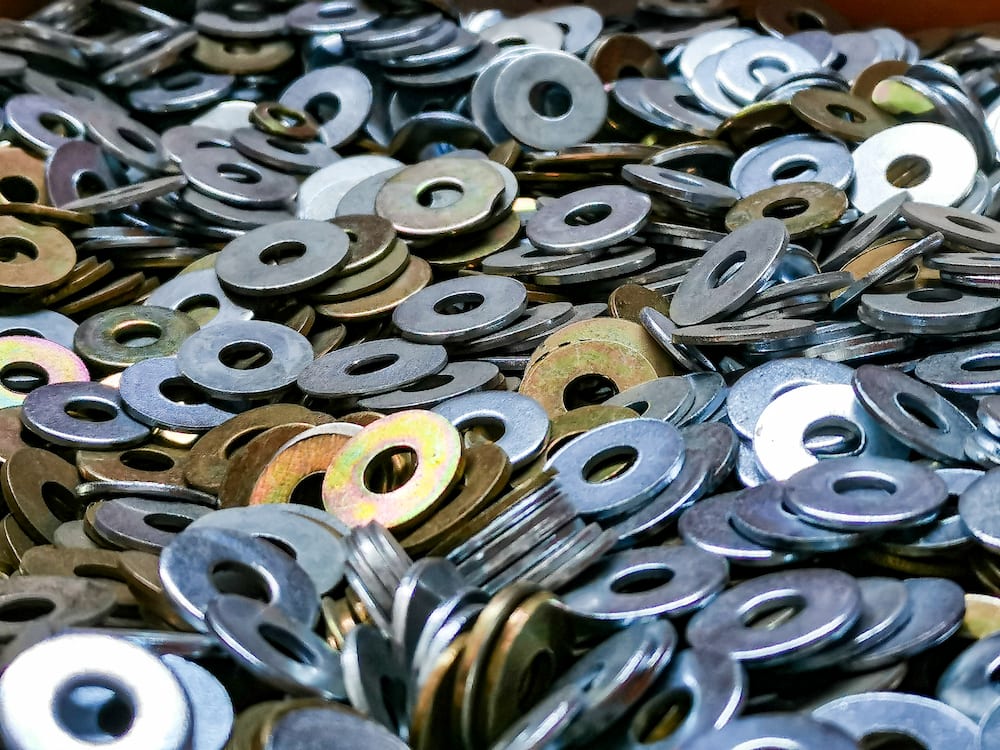
While both spring and flat washers are used with fasteners, they serve different purposes.
Flat washers are thin, circular metal discs with a central hole. They distribute the load of the fastener over a larger surface area, preventing damage to the mating surface and reducing the risk of pull-through. They are commonly used in general-purpose applications where a spring-like action is unnecessary.
Meanwhile, spring washers have a conical shape that provides a spring-like action. This shape lets them maintain tension and preload in a joint, preventing loosening and absorbing shock. They are essential in applications where vibration, thermal expansion, or dynamic loading are present.
How to Use a Spring Washer
- Select the correct type and size: Choose a spring washer compatible with the fastener and the application requirements. Consider factors such as the fastener’s size, the materials being joined, and the expected load and environmental conditions.
- Position the spring washer: Place the spring washer between the fastener head and the mating surface. Ensure that the washer is correctly oriented to provide the intended spring action.
- Tighten the fastener: Tighten the fastener to the recommended torque specification. The spring washer will compress as the fastener is tightened, providing tension and preload in the joint.
- Inspect the joint: Periodically inspect the joint to ensure that the tension is maintained. If the joint becomes loose or the tension is lost, you may need to replace the spring washer or adjust the torque on the fastener.
Spring Washer Installation Best Practices
Proper installation is crucial for spring washers to function effectively and perform optimally. Here are some best practices to follow when using spring washers:
- Use compatible materials: To prevent galvanic corrosion, use washers and fasteners made of compatible materials. For example, avoid using a brass spring washer with a carbon steel bolt, as dissimilar metals can accelerate corrosion.
- Select the right size and type: When selecting the size and type for your spring washer, ensure that it meets the load requirements so that you have sufficient tension and torque in the assembly.
- Proper placement: Position the spring washer correctly between the fastener head and the mating surface. Ensure that the washer sits flat and is not tilted or misaligned.
- Correct washer sequence: When using both flat washers and spring washers, ensure the correct spring washer and flat washer order. The flat washer should be placed first, followed by the spring washer. This arrangement helps to distribute the load evenly and prevent damage to the mating surface.
Standards and Compliance in Australia
Spring washers used in critical applications must often comply with specific standards to ensure safety and functionality.
- AS 1252.1:2016: This Australian standard specifies requirements for high-strength steel fasteners, including spring washers used in structural assemblies.
- ISO 7089/7090: These international standards specify the dimensions and mechanical properties of plain washers, ensuring consistency and interchangeability.
- DIN 6796: This German standard specifies the characteristics of conical spring washers for bolted connections.
Apart from washers, we also supply other mechanical hardware and electrical components, from various resistor types to different button battery sizes. Browse our offerings online to kickstart your projects and enjoy deliveries at your convenience.
Further Reading

Self-Tapping Screws Guide
Need more information on which self-tapping screw to use in your project? Our guide explains the different options and how to use them.

Everything You Need To Know About O-Rings And Seals
In our comprehensive guide we look at what o-rings and seals are, what they’re used for, as well as the different types that are available on the market.

Cordless Screwdrivers Guide
In our comprehensive Cordless Screwdriver guide we look at the different types available on the market. We also cover the key features and benefits ads well as offering some handy tips to help you choose the right one for the job in hand.
Related links
- RS PRO Stainless Steel Plain Spring Washer DIN 7980
- Washers
- RS PRO Steel Bright Zinc Lock Washers DIN 7980
- Baumer Spring Washer 30 mm for Use with Encoder, Counter
- RS PRO Steel Bright Zinc Lock Washers DIN 7980
- Baumer Z119 Series Torque Support & Spring Washer 9.5 mm Shaft
- Tap Washer Buying Guide
- Washer Kits