Slide Switches
Slide switches are vital components for managing current flow in electrical circuits. They use a mechanical slider to easily turn the current on and off, moving between open and closed positions. These switches are particularly well-suited for smaller circuits and are commonly found as primary power switches in compact, battery-operated devices.
One of the key advantages of slide switches is their distinct tactile shape, which allows users to effortlessly distinguish between on and off states. The toggle action provides clear physical feedback, enhancing user confidence.
Our extensive range of slide switches caters to various applications in Australia, with voltage ratings from 4 V dc to 400 V ac and contact resistances spanning from 10 milliohms to 10 ohms.
How Do Slide Switches Work?
Slide switches operate through a straightforward mechanical action. A physical slider moves along a track, which in turn shifts internal electrical contacts. Moving the slider physically makes or breaks connections within a circuit, directing current flow.
Typically, slide switches are used for simple on-off applications, sliding between Normally Open (NO) and Normally Closed (NC), though other switch functions are available in the RS Range. These include:
- Maintained: A maintained switch operation ensures a switch is physically kept in an actuated position. It works well for set it and leave it applications such as turning a device on and off.
- Break Before Make (BBM): This configuration ensures contact in the switch is broken before a new connection path is made, and is usually preferred in power applications.
- Make Before Break (MBB): This configuration ensures a new connection path is established before the previous connection is broken. The centre contact of a switch is momentarily connected to both contacts, ensuring there is no interruption of power, which is useful when continuous operation is vital.
Internal mechanisms, often involving springs and detents, ensure the slider maintains its actuated position. Users recognise this as a maintained switch operation, suitable for 'set it and leave it' uses like turning a device on or off. Different internal contact configurations—including 2-position, 3-position, or even a 5-position toggle slide switch—enable specialised operations.
What Are Typical Applications of Slide Switches?
Slide switches are ubiquitous in countless applications, valued for their simple, reliable operation and compact size. They provide straightforward control in a wide array of devices and systems.
- Small Consumer Electronics: One often finds slide switches as on/off controls or mode selectors in everyday devices. Think about toys, portable radios, or calculators where a clear, tactile switch is needed.
- Medical Devices: Slide switches offer reliable low-power signaling in various medical devices. Their dependable operation makes them suitable for critical functions where precise control is required in diagnostic or therapeutic equipment.
- Industrial Control Panels: In industrial settings, slide switches serve as robust components for low-power signaling on control panels. They allow operators to select modes, enable functions, or indicate status clearly and simply.
- Test and Measurement Equipment: Many test and measurement instruments incorporate slide switches for range selection or function toggling. Their clear positions help users accurately select parameters, ensuring reliable readings and precise operation.
- DIY Electronics Projects: Hobbyists and students frequently choose slide switches for DIY electronics projects. Their ease of wiring and straightforward mechanical action make them a popular choice for prototyping and simple control circuits.
Slide Switch Mounting Types
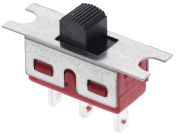
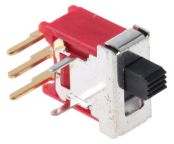
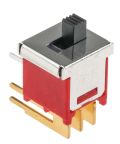
Slide switches come in many variations, making them adaptable for diverse electronics projects. They may come as snap-in components, for easy of mounting, or with screw hole options for when further rigidity is preferred.
One can categorise them by their number of positions, operational function, mounting type, or internal contact configuration. Choosing the right type depends on the specific circuit design and user interaction required.
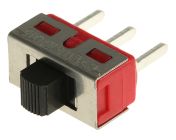
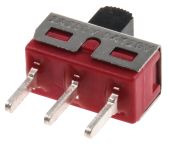
- Single-Pole, Double-Throw (SPDT) Switches: These are common slide switches with three terminals. They control one circuit, allowing you to switch a single input between two different output paths, functioning as an on-off-on selector.
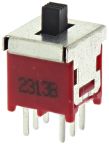
- Double-Pole, Double-Throw (DPDT) Switches: DPDT slide switches have six terminals and manage two separate circuits simultaneously. Each pole can switch between two throws, making them ideal for more complex control applications where multiple connections need to be toggled.
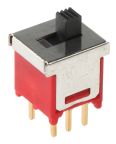
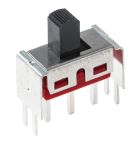
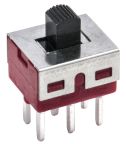
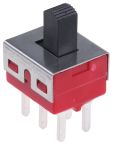
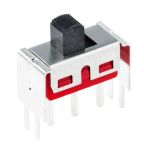
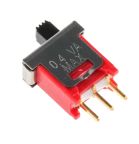
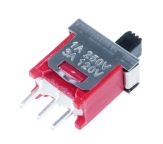
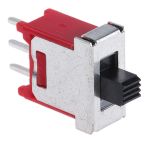
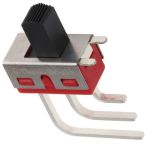
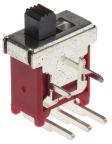
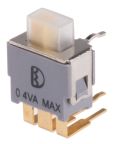
- Through-Hole Mounted Switches: Designed for secure attachment directly to a printed circuit board, these slide switches have leads that pass through holes. They provide a rigid connection, ideal for applications requiring robust mounting.
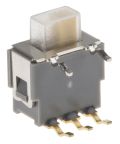
- Surface-Mount Device (SMD) Switches: SMD slide switches are compact and mount directly onto the surface of a printed circuit board. Their smaller footprint makes them suitable for miniaturised electronics and automated assembly processes where space is limited.
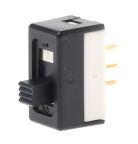
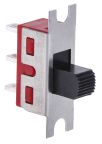
- Panel Mount Switches: Specifically designed to be mounted onto the exterior panels of equipment or enclosures. Panel mount switches often feature snap-in designs for easy installation or screw holes for added rigidity.
- Maintained (Latching) Switches: A maintained slide switch remains in its actuated position until physically moved again. Such operation is perfect for 'set it and leave it' applications, like turning a device completely on or off without continuous pressure.
- Momentary Switches: Momentary slide switches return to their default position once released. They are typically used for temporary actions, like a test button or a temporary connection, providing control only while the slider is actively held.
How to Choose the Right Slide Switches
Selecting the correct slide switch is essential for ensuring safe, reliable, and effective circuit control in any electronics project or product. Here's a quick guide on how to choose the right slide switch for various applications:
- Application Requirements: Determine the switch's exact function. For simple on/off control, basic types work well, while more complex applications might need a 2-position, 3-position, or even a 5-position switch for multi-positional control.
- Electrical Ratings (Voltage & Current): Verify the switch's maximum voltage and current ratings. Choosing a slide switch that can safely handle the circuit's electrical load prevents overheating or premature failure.
- Number of Poles and Throws: Consider the complexity of the circuit you need to control. Single-pole, double-throw (SPDT) switches are for simple switching, while double-pole, double-throw (DPDT) options manage multiple isolated circuits.
- Mounting Type: Match the slide switch to your installation method. Options include through-hole mounting for secure PCB attachment, surface-mount device (SMD) for compact designs, or panel-mount for external user access.
- Physical Size and Form Factor: Space constraints within your design often dictate the switch's physical dimensions. Consider the overall footprint and height, alongside the desired external appearance for the final product.
- Actuator Style: The slider's design impacts user interaction and feel. Options range from small, subtle actuators for internal use to larger, more tactile ones for frequent external operation, influencing ergonomics and accessibility.
- Environmental Conditions: Assess the operating environment. If exposed to dust, moisture, or extreme temperatures, select a slide switch with appropriate sealing (e.g., IP rating) and material construction to ensure long-term reliability.
- Durability and Lifespan: For applications involving frequent toggling, look at the switch's mechanical and electrical life cycles. A higher cycle rating indicates greater durability and a longer operational lifespan for the slide switch.
Your Leading Supplier and Distributor of Slide Switches in Australia
RS is your trusted partner for high-quality slide switches. We provide a comprehensive portfolio from world-leading manufacturers like NIDEC COPAL ELECTRONICS GMBH, C & K, and KNITTER-SWITCH. Our extensive stock includes numerous mounting options, from bracket mounts for secure internal PCB or sub-assembly integration to panel mounts for external user access and robust enclosure attachment.
We also offer a wide catalogue of switch types, ensuring you find the perfect control solution for any project. Explore our range including push button switches, rope pull switches, and limit switches. Buy your slide switches and other essential components online today. For comprehensive information on our ordering options, shipping services, and any applicable delivery charges, please visit our delivery page.
Popular Searches
Related links
- RS PRO PCB Slide Switch DPDT On-Off-On 5 A @ 28 V dc Top
- RS PRO Through Hole Slide Switch SPDT Latching 5 A @ 28 V dc Top
- Nidec Components PCB Slide Switch SPDT 100 mA @ 6 V dc Slide
- Molveno Panel Mount Slide Switch SPST-2NC 8 A Toggle
- C & K PCB Slide Switch DPDT 6 A @ 250 V ac Slide
- Nidec Components Through Hole Slide Switch 4P12T (On)-(On) 10 mA Slide
- Cam Switches
- RS PRO PCB Slide Switch SPDT On-Off-On 5 A @ 28 V dc Top