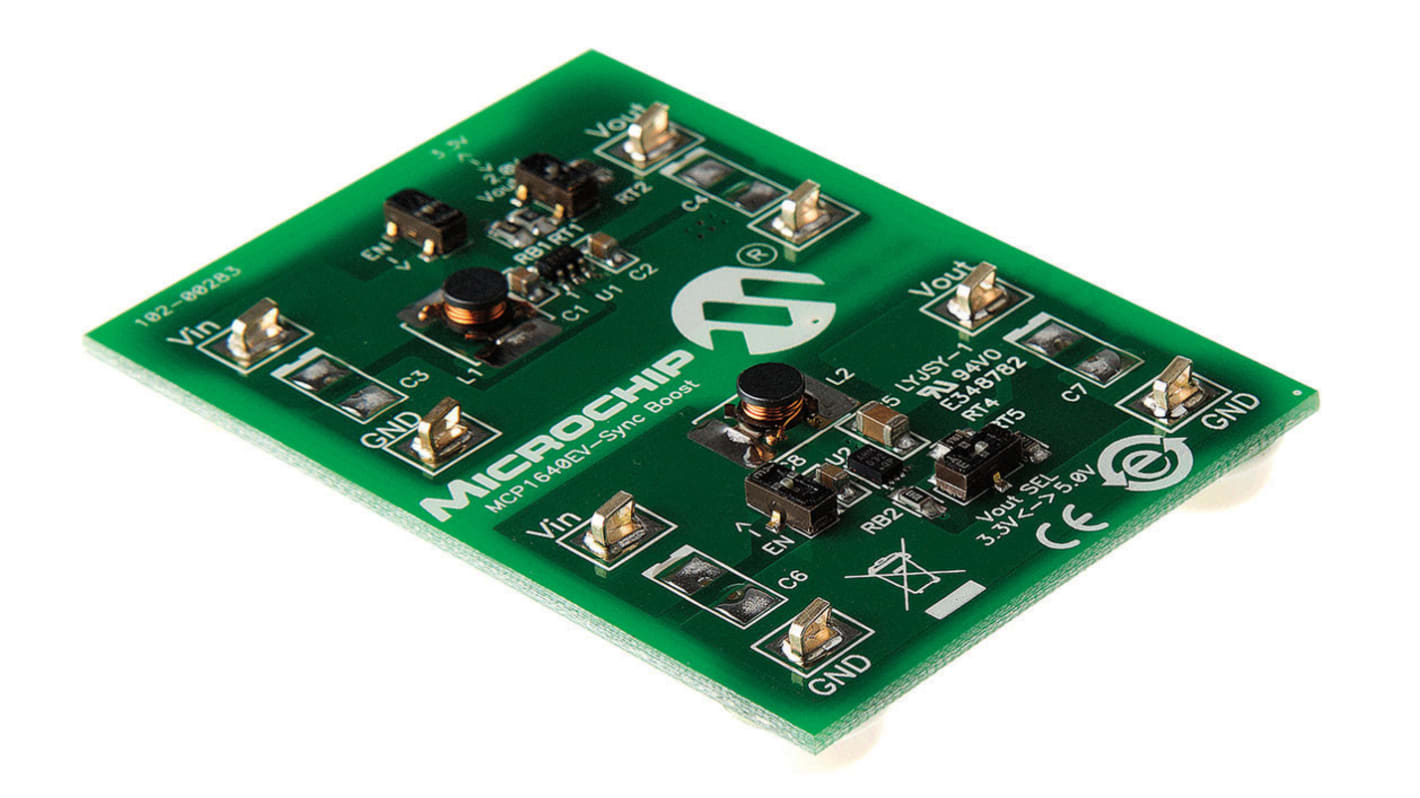
Microchip Evaluation Board Boost Converter for MCP1640
- RS Stock No.:
- 742-4248
- Mfr. Part No.:
- MCP1640EV-SBC
- Brand:
- Microchip

Bulk discount available
Subtotal (1 unit)*
$74.37
(exc. GST)
$81.81
(inc. GST)
FREE delivery for orders over $60.00 ex GST
Temporarily out of stock
- Shipping from 16 March 2026
Need more? Click ‘Check delivery dates’ to find extra stock and lead times.
Units | Per unit |
|---|---|
| 1 - 4 | $74.37 |
| 5 + | $71.92 |
*price indicative
- RS Stock No.:
- 742-4248
- Mfr. Part No.:
- MCP1640EV-SBC
- Brand:
- Microchip
Specifications
Technical data sheets
Legislation and Compliance
Product Details
Find similar products by selecting one or more attributes.
Select all | Attribute | Value |
|---|---|---|
| Brand | Microchip | |
| Power Management Function | Boost Converter | |
| Product Type | Boost LED Regulator Evaluation Board | |
| Kit Classification | Evaluation Board | |
| Featured Device | MCP1640 | |
| Kit Name | Evaluation Board | |
| Standards/Approvals | ISO | |
| Select all | ||
|---|---|---|
Brand Microchip | ||
Power Management Function Boost Converter | ||
Product Type Boost LED Regulator Evaluation Board | ||
Kit Classification Evaluation Board | ||
Featured Device MCP1640 | ||
Kit Name Evaluation Board | ||
Standards/Approvals ISO | ||
- COO (Country of Origin):
- CN
MCP1640 Boost Converter Evaluation Board
This evaluation board uses the MCP1640 in a high-efficiency (up to 96%), fixed frequency (500MHz), step-up DC-DC converter
Easy-to-use and minimum number of external components power supply solution for applications powered by one-cell, two-cell, or three-cell alkaline, NiCd/NiMH; one-cell Li-Ion or Li-Polymer batteries
Selection of the best operating mode for efficiency (PWM/PFM)
A wide input voltage range (0.35 to 5.5V) and low start-up voltage (0.65V)
PCB layouts recommendation for SOT23-6 and 2x3mm-8 DFN packages
Three common output voltages to evaluate: 2.0V, 3.3V and 5.0V enable selection (when disabled, the MCP1640 disconnects the path from input to output for true-disconnect).
Input voltage range, VIN: 0.35V to 5.5V, with VIN ≤ VOUT; 1mA load after start-up
Fixed output voltage: 2.0V or 3.3V and 3.3V or 5.0V, selected using a mini dip switch on board
Output current: typical 100mA @ 3.3V Output, 1.2V Input or 350mA @ 5.0V Output, 3.3V Input
Start-up voltage: 0.65V at VIN = 1.2V, VOUT = 3.3V and IOUT = 1mA, resistive load
Automatic PFM/PWM Operation
PWM Switching Frequency = 500 kHz
Enable state selectable using mini-dip switch on board
Peak Input Current Limit up to 800mA
Over-temperature (if the die temperature exceeds 150°C, 10°C hysteresis)
Related links
- Microchip Single Cell Boost Converter Boost Converter for MCP16251 for Cell
- Brand-Rex Boost 8 Click Boost Converter for LT1945
- STMicroelectronics Isobuck Boost Converter Buck-Boost Converter for ST A6986I for 3-Phase Inverters
- Brand-Rex Buck & Boost Click Buck-Boost Converter for MIC7401
- Renesas Electronics ISL9122AIIN-EVZ Buck-Boost Converter for ISL9122AIIN
- ROHM Evaluation Board for BD8306MUV Buck-Boost Converter for BD8306MUV
- onsemi Boost Evaluation Board Buck-Boost Converter for NCP1608BDR2G for Pre-Converter in AC-DC Adapter
- Infineon SBC-SHIELD-TLE9471 DC-DC Converter for TLE9471-3ES for Arduino