Oscilloscope Probes
Oscilloscope probes are a type of device commonly used by electrical engineers that can connect a signal source to an oscilloscope. The probe is a single input device that can divert the electrical signal to the scope. Oscilloscope probes can be used in various applications and can range from a simple wire like a passive probe to a more complex device.
An oscilloscope is considered to be the most used instrument for electrical engineers who need to measure electrical characteristics of electronic devices, but its operational utility is fundamentally dependent on the integration of a high-fidelity probe to facilitate precise signal acquisition.
How Oscilloscope Probes Work
The fundamental operation of a standard passive oscilloscope probe relies on the voltage divider principle to manage signal integrity and instrument safety. When a technician utilizes a 10x oscilloscope probe, they are employing a resistive-capacitive (RC) network that creates a 10:1 attenuation ratio. This is achieved by placing a $9\text{ M}\Omega$ resistor in series with the oscilloscope’s internal $1\text{ M}\Omega$ input impedance.
The Voltage Divider and Loading Effects
By increasing the total resistance seen by the DUT, the probe significantly reduces the current drawn from the circuit, thereby mitigating "loading effects" that could otherwise distort the signal or cause the circuit to malfunction. Furthermore, the 10x attenuation provides a secondary layer of protection for the oscilloscope’s input stages by scaling down high-magnitude voltages to levels within the instrument's safe operating range.
Compensation and Frequency Response
To ensure a flat frequency response across the probe’s rated bandwidth, an adjustable compensation capacitor is typically included in the probe head or the BNC connector housing. This compensates for the input capacitance of the oscilloscope and the capacitance of the coaxial cable. Without proper compensation, square waves will exhibit rounding or overshooting, leading to inaccurate rise-time measurements in high-speed digital circuits.
Applications of Oscilloscope Probes
Oscilloscope probes are indispensable across a wide array of industrial sectors where signal verification and fault diagnosis are paramount. Their ability to capture transient events and steady-state waveforms allows for the validation of complex electronic systems.
Power Electronics and Switching Power Supply Design
In the development of Switched-Mode Power Supplies (SMPS), engineers must measure signals that are not referenced to ground. Using a differential scope probe allows for the safe measurement of gate-to-source voltages on high-side MOSFETs or across current-sense resistors. This is critical for assessing switching losses and ensuring that power components operate within their Safe Operating Area (SOA).
Automotive Sensor Testing and Mechatronics
The automotive industry relies on probes to diagnose Engine Control Unit (ECU) signals and sensor outputs. Probes are used to analyse Controller Area Network (CAN) bus integrity and pulse-width modulated (PWM) signals sent to actuators. The rugged nature of passive probes makes them suitable for the harsh electromagnetic environments found in modern vehicle engine bays.
High-Speed Data Bus Analysis
For industrial automation systems utilizing USB, Ethernet, or LVDS communication, high-bandwidth active probes are required. These probes offer extremely low capacitive loading (often less than 1 pF), which is essential for preserving the steep edges of high-speed data packets. This allows engineers to perform eye-diagram analysis and jitter measurements to ensure compliance with communication standards.
Power Consumption Profiling
An oscilloscope current probe is utilized to measure the current draw of industrial components without breaking the circuit. By employing Hall Effect sensors or transformer coils, these probes convert current into a proportional voltage signal for the oscilloscope. This is vital for profiling the power consumption of battery-operated IoT devices or monitoring the inrush current of industrial motors.
Oscilloscope Probe Types
Choosing the correct probe architecture is determined by the signal's voltage, frequency, and reference point.
Passive Probes
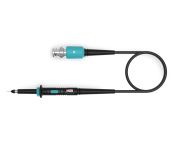
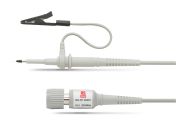
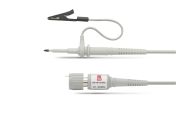
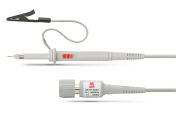
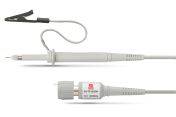
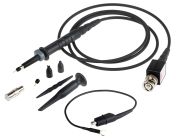
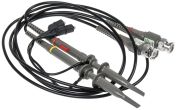
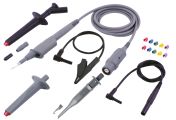
Passive probes are the industry standard for general-purpose testing. They are rugged, cost-effective, and provide a wide dynamic range. While a 1x probe is available for low-level signals, the 10x CRO or DSO probe is the preferred choice for its higher input impedance and broader bandwidth capabilities.
Differential Probes
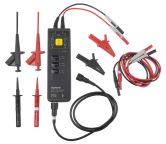
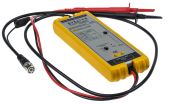
Differential probes are engineered to measure the voltage difference between two test points where neither point is at ground potential. This is essential for "floating" measurements in three-phase power systems or balanced communication lines, as it eliminates the risk of short circuits that occur when using standard single-ended probes.
Current Probes
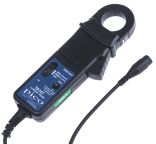
These clamp-on devices allow for the non-intrusive measurement of AC or DC currents. High-sensitivity variants are used for low-power electronics, while industrial-grade versions can handle hundreds of Amperes for heavy machinery diagnostics.
High-Voltage Probes
For power distribution and high-energy physics, specialized 100x oscilloscope probe variants (or higher) are used. These probes feature reinforced insulation and extended physical lengths to prevent arcing and ensure operator safety when measuring kilovolt-level signals.
How to Install Oscilloscope Probes
The installation of an oscilloscope probe requires attention to both mechanical and electrical connection points to ensure measurement accuracy.
- Connection to the Oscilloscope: Attach the BNC connector to the desired channel. For "intelligent" probes, ensure the interface pins are properly seated to allow the scope to automatically detect the attenuation factor.
- Probe Compensation: Before taking measurements, connect the probe tip to the oscilloscope's internal square-wave reference (usually a 1 kHz terminal). Use the provided adjustment tool to tune the compensation capacitor until the displayed waveform is perfectly flat.
- Grounding: Connect the ground lead to the nearest possible ground point on the DUT. In high-frequency applications, the long ground lead can act as an inductor, causing "ringing"; in these cases, use a short ground spring or a dedicated PCB socket.
- Tip Selection: Choose the appropriate tip (hook, needle, or BNC adapter) based on the test point's accessibility and the required mechanical stability.
How to Choose the Right Oscilloscope Probe
Selecting a probe involves balancing technical specifications with the specific requirements of the application.
- Bandwidth: The probe's bandwidth should ideally be at least five times the highest frequency component of the signal being measured to ensure accurate rise-time capture.
- Attenuation Ratio: Consider the signal magnitude. A 10:1 probe is standard, but a 100:1 or 1000:1 probe is necessary for high-voltage power electronics to prevent instrument damage.
- Input Impedance and Capacitance: For high-impedance circuits, select a probe with the highest possible resistance and lowest capacitance to prevent circuit loading.
- Safety Ratings: Ensure the probe carries the appropriate Measurement Category (CAT) rating for the environment, such as CAT II or CAT III for industrial mains measurements.
- Connectivity: Verify that the probe’s connector is compatible with your oscilloscope’s input (e.g., standard BNC or a proprietary manufacturer interface).
The Leading Supplier and Distributor of Oscilloscope Probes in Australia
RS Australia serves as a premier source for high-performance oscilloscope probes, maintaining a comprehensive inventory from industry-leading manufacturers such as Teledyne LeCroy, Keysight Technologies, and RS PRO. Our selection encompasses a wide range of technical specifications and probe architectures at competitive price points, ensuring that procurement managers and engineers can identify the optimal measurement interface for any industrial or laboratory application.
We also supply an extensive array of complementary diagnostic hardware, including oscilloscopes and multimeters, to fully equip your testing facility. Secure your passive probes, high-voltage differential probes, or current clamps through our online platform today. For further information regarding our procurement processes, shipping timelines, and logistical costs, please consult our dedicated delivery information page.


Popular Searches
Related links
- Oscilloscope Probe Accessories
- ESD Tools
- Inspection Mirror Probes
- Pico Technology TA152 Probe Tip to BNC Adapter Oscilloscope Adapter, For Use With 2.5 mm Scope Probes
- Oscilloscope Cables
- Pico Technology TA301 Oscilloscope Probe D9 Connector
- RS PRO RS-TP Series Oscilloscope Probe 100 MHz BNC Connector
- Teledyne LeCroy ZD Series ZD200 Oscilloscope Probe Differential Type 1:1